A bit of History
As the Nancy Forestry School points out in an article published on the occasion of its 200th anniversary, “Silviculture is the cultivation of the forest or all the forester’s interventions to produce wood sustainably, while taking into account all environmental and social issues. With today’s challenges related to climate change, one might think that silviculture is a recent practice. Yet, it has its roots in often ancient practices.”
In France, a land of forests, forestry is a serious matter that was taken into account by the administration very early on. There is a true “forest culture” anchored in history, architecture, and even in the organization of power itself, starting in the Middle Ages.
The title of “Master of Waters and Forests” appeared in 1219, and many texts from then on regulated the management of woods, laying the foundations of forest law.
The most famous of these is Colbert’s Ordinance of 1669, commissioned by Louis XIV with the participation of foresters such as Louis de Froidour, which remained the reference for over a century. A “code” of forest management, the Ordinance of 1669, however, remained vague on silvicultural techniques. As the Nancy Forestry School points out, it was not until the 18th century that genuine scientific thinking on forests emerged. Naturalists such as Réaumur, Buffon, and above all Duhamel du Monceau—considered the father of silviculture—laid the foundations of a new approach. With the help of foresters such as Varennes de Fenille, they observed, experimented, and disseminated their conclusions. They demonstrated, in particular, that cutting trees at 30 or 40 years of age was more judicious given society’s needs. Their main discovery concerned the value of thinning: by gradually removing certain trees, the finest specimens were able to fully develop. These advances paved the way for a true revolution: that of rational forest management, where humans do not exhaust nature but instead accompany its growth.
Here, we offer a brief immersion into the contemporary French world of silviculture, its stakeholders, and its challenges.
What is silviculture?
Larousse definition
“All techniques enabling the creation and rational exploitation of forests while ensuring their conservation and regeneration.”
Foresters’ definition
Silva, in Latin, means forest. Silviculture consists in guiding and steering the natural evolution of forests so that they meet society’s needs for wood (wooden houses, furniture, etc.). French foresters summarize their practice with this simple adage: “Observe nature, hasten its work.”
The fields of action of irregular silviculture
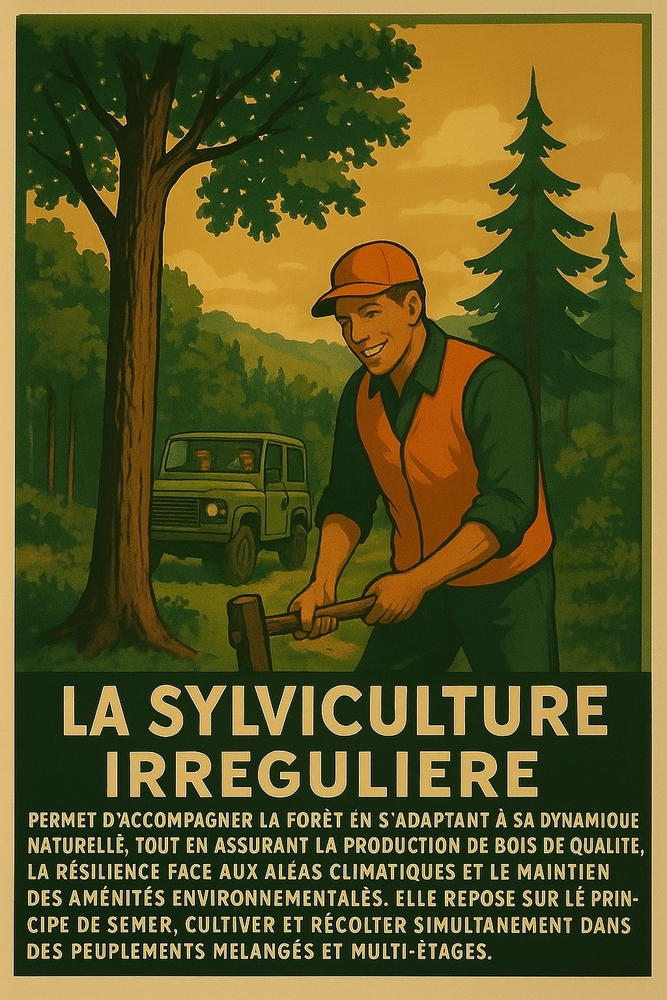
As the Comité des Forêts explains, “Irregular silviculture allows the forest to be accompanied in adapting to its natural dynamics, while ensuring the production of quality wood, resilience to climatic hazards, and the maintenance of environmental amenities. It is based on the principle of sowing, cultivating, and harvesting simultaneously in mixed, multi-layered stands.”
These operations require studies, improvement work, maintenance, regeneration cuts, thinning, or sometimes even final cuts followed by replanting when health conditions demand it. Silviculture also encompasses the proper management of light, water, and soil.
Silviculture in the fight against climate change
Forests capture oxygen
Forests hold many solutions for combating climate change and preserving nature. It is estimated that the world’s forests absorb about 10% of human-caused CO�?? emissions each year. Through photosynthesis, trees capture CO�?? from the atmosphere, storing it in their biomass as well as in forest soils.
Beyond capturing CO�??, forests are indispensable for oxygen production, essential for life on Earth. They regulate the local climate by influencing temperature, humidity, and rainfall, helping mitigate heatwaves and droughts. By investing in the preservation, restoration, and development of this precious ecosystem, foresters now bear the responsibility of effectively combating climate change and contributing to altering the fatalistic projections about our planet’s future.
Forests shelter numerous species
Forests, true treasures of biodiversity, are essential to the survival of countless species. As a complex ecosystem, they provide varied habitats supporting a multitude of organisms, from majestic trees to the smallest creatures. Around 80% of terrestrial biodiversity lives in forests.
Forests provide water
Forests play a crucial role in the water cycle, acting as a natural regulator for the supply of water to humans and animals. Thanks to their dense cover, they promote rainfall infiltration. Leaves and canopy intercept rain, reducing runoff and allowing water to slowly seep into the soil. This process helps recharge groundwater and maintain soil moisture levels.
Tree roots extend deep, creating channels that further facilitate infiltration. They stabilize the soil and prevent erosion, keeping water available for plants and other organisms.
The organic matter in forest soil itself retains water, vital for the sustainability of forest ecosystems. Thus, in times of drought, forests act as reservoirs: trees release moisture into the air through transpiration, creating more humid microclimates that can influence rainfall. This supports not only the forest itself but also surrounding areas, benefiting agriculture and other human activities.
Forests are therefore a genuine solution for water management. They regulate the water cycle and ensure the availability of this essential resource, contributing to ecosystem resilience in the face of climate change.
Forests produce timber for construction
Silviculture aims to produce wood of exceptional quality while regulating the growth and health of forest stands.
For foresters, the ambition is to observe the natural environment, understand its evolution, and calibrate their interventions accordingly… It is both a learning process and a fascinating practice. In France, the impact of good forest management is visible in forest tracts under a Plan Simple de Gestion (PSG)—management plans mandatory for estates larger than 25 hectares. Such plans approach forests as entire ecosystems, including:
-
the diversity of plants and animals typical of the station and the region (specific diversity);
-
the genetic diversity and quality of plant and animal populations, maintaining their capacity to evolve and adapt (a key asset under climatic uncertainty);
-
the variability of forest structures, in terms of dimensions/species/layers, typical of the station and region (structural diversity);
-
the proper functioning of ecological processes and natural successions underway;
-
ecological interrelations, including beyond the forest’s borders (networks, corridors);
-
the ecological influence of forests on their environment (from microclimate to global climate) and on landscapes;
-
the maintenance of natural soil fertility, notably due to the mineralization of dead organic matter, linked to continuous forest cover over time and space.
Silviculture: different silvicultural systems
The vocabulary of silviculturists can sometimes be confusing, as the same terms describe both the stand, its current state, and the system of interventions. For example, futaie régulière (even-aged high forest) means both:
-
a stand with seed-origin trees of similar diameter,
-
and a treatment characterized by separating interventions over time (improvement, harvest, regeneration).
Today, four main systems are applied in French forests:
-
simple coppice,
-
even-aged high forest (futaie régulière),
-
coppice-with-standards (taillis sous futaie),
-
uneven-aged high forest (futaie jardinée).
Simple coppice
Unlike high forest, coppice refers to trees arising from vegetative multiplication (stump sprouts or root suckers). A simple coppice is a stand where periodic clearcutting is practiced. Species whose stumps sprout vigorously after cutting (e.g., chestnut, linden, hornbeam, oak, aspen, birch, alder, ash, acacia) may form coppices.
For coppicing to be economically viable, harvested shoots must yield marketable products. But for coppices to regenerate vigorously, they must be harvested relatively young. Hence, each species has a different “rotation age.” In general:
Even-aged high forest
A futaie is a stand of seed-origin trees, i.e., sexually reproduced. An even-aged high forest originates from natural/artificial seeding or planting, with trees of roughly the same age. This produces an equienne (even-aged) stand forming a closed canopy that rises as the stand matures.
Example: The famous Tronçais forest (~11,000 ha in Allier, France), arranged by Colbert, is known for its exceptional oaks. Once heavily cut, it has regrown and now contains centuries-old specimens.
Coppice-with-standards
This system combines coppice (understory) and high forest (overstory). Because light is limited, coppice can only thrive if the overstory is discontinuous.
Uneven-aged high forest (futaie jardinée)
Here, trees of all ages, sizes, and species are mixed. Though appearing anarchic, stands are carefully regulated, with tree numbers per size-class defined by managers according to fertility and species. Each harvest aims to restore this balance; otherwise, the stand degenerates into a regular stand without continuous renewal.
Who are the stakeholders of silviculture in France?
-
Private stakeholders
Private forests cover 75% of France’s forested area. Owners are at the forefront of silviculture, deciding policies for their parcels within regulations. The Comité des Forêts is a landowners’ syndicate linking experts with forest owners, offering training and resources to foster sustainable silviculture.
-
ONF – Office National des Forêts
Public body managing public forests (25% of French forests, ~10 million ha), with roles in sustainable management, biodiversity, public access, and risk prevention (fire, erosion, dune stabilization). It also engages internationally in bioenergy.
-
FRANSYLVA – Fédération des Forestiers Privés de France
Federation representing private forest owners, defending their interests nationally and at the EU level. Provides legal/fiscal advice and publishes Forêts de France.
-
CNPF – Centre National de la Propriété Forestière
Public body overseeing private forests (11 million ha, ~20% of national territory). Approves sustainable management plans (Plan Simple de Gestion) and provides silvicultural training and advice.
-
EFF – Experts Forestiers de France
Professional union of forest experts, offering technical, commercial, and patrimonial services to private owners, with independence ensuring impartiality.
-
UCFF – Union de la Coopération Forestière Française
Federation of forest cooperatives (17 co-ops, 112,000 members), acting as an interface between private forest owners and industry. Supports sustainable rural development.